

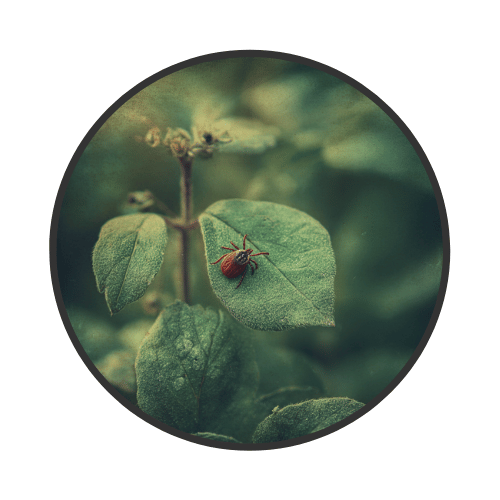
Last summer, my four year old daughter India was bitten by a tick on the left side of her scalp. It was so small that it was barely visible. Even with a tick removal tool, it was hard to pull out, but once it was, we thought nothing more of it. She seemed fine. There was no rash. No fever. Just summer.
Two weeks later, my husband looked at her and said, “Her face looks like it’s drooping.” He was right… the left side of her face seemed to sag, her smile uneven, her eye not quite closing properly. We took her straight to the doctor, who said it was probably Bell’s Palsy, likely from a mild viral infection. We were reassured and sent home.
The very next day, we returned to the doctor’s office. This time, they ran blood tests, including one for Lyme disease. Everything came back negative.
Then came day three.
India was in a lot of pain. She lay curled in a ball. She couldn’t bear light. She wouldn’t move. A large red patch had now appeared on her left cheek, in a direct line below the tick bite. A pediatric specialist was sent a photo of this and recognized it as a “bull’s-eye” rash, a classic sign of Lyme disease.
The full diagnosis at the hospital was neuroborreliosis, a severe form of Lyme disease where the bacteria had infected her central nervous system. And more concerning, it had progressed into bacterial meningitis.
Lyme disease is caused by Borrelia burgdorferi, a bacterium carried by infected ticks. In many cases, the infection spreads slowly through the bloodstream, causing flu-like symptoms or joint pain. But sometimes (especially if the tick bites near the head or spine), the bacteria can bypass the bloodstream altogether and travel directly into the nervous system. It took a lumbar puncture (testing the spinal fluid) to show what was happening to India.
Once in the nervous system, the bacteria triggered inflammation of the meninges, the protective layers surrounding the brain and spinal cord. This condition is called Lyme meningitis — a form of bacterial meningitis caused by the Borrelia bacteria (not to be confused with the classic bacterial meningitis caused by organisms like Neisseria meningitidis or Streptococcus pneumoniae).
India lost vision in her left eye, hearing in her left ear, and had total paralysis on the left side of her face.
Today, she is home and has started to attend school again. As the brain inflammation subsided, her hearing and vision returned and continue to improve slowly.
She has weekly physical therapy. She can now close her eye! She can drink from a straw again. Her smile is still uneven, and sometimes she tells me, “Mummy, I can’t smile yet… my cheek is still angry.” While she will have some lasting impairments in all these areas, they are far less severe than we were originally told to expect. With ongoing support, mainly through natural supplements, I’m hopeful that her recovery will go even further.
Ticks aren’t born carrying Lyme disease. They become infected themselves. This happens when a young tick, known as a larva, feeds on a small animal that already carries the Borrelia burgdorferi bacteria — most often a mouse, vole, or certain species of birds. During that blood meal, the bacteria are transferred into the tick’s system. As the tick grows into its nymph and later adult stages, it retains the infection and can then pass Lyme disease to humans or pets when it bites again. Ticks are incredibly patient. They don’t fly or jump. Instead, they crawl up to the tip of tall grass or a low bush and wait with outstretched front legs, a behavior known as ‘questing’. When a human or animal brushes past, the tick grabs on, often unnoticed, and slowly begins to feed. They secrete a numbing agent so you don’t feel the bite.
Ticks are active from spring through late autumn, especially in grassy, wooded, or damp areas. Tick prevention is always best, but early recognition is just as important.
How to Protect Your Family from Ticks and Lyme Disease
(After being in a tick-prone environment — such as woodlands, rural areas, fields, or even large gardens — the risk of tick bites is far lower in highly urban, paved environments!!)
- Check the body - Especially behind ears, in hairlines, around the neck, waist, and behind the knees (known as ‘Hot Spots’).
- Wear Protective Clothing - Long sleeves, trousers tucked into socks, light-coloured clothes to spot ticks easily.
- Run outdoor clothes through a hot tumble dry — ticks can survive a washing machine.
- Use Repellent -Lemon eucalyptus oil is a good natural option.
- Shower Children After Outdoor Play -Ticks can take time to attach — showering within two hours can wash them off before they embed.
What To Do If You Find an Embedded Tick
- Don’t Panic – Stay calm and act carefully. Most tick bites are harmless. Use Fine-Tipped Tweezers or a Tick Remover Too. Pull slowly and steadily upwards — don’t twist or jerk, as this can leave parts behind.
- Do Not Use Home Remedies - Avoid burning, Vaseline, alcohol, or essential oils while the tick is attached, these can cause it to release more bacteria.
- Clean the Area Thoroughly - Wash with soap and water, then apply antiseptic or iodine.
- Save the Tick (If Possible) - Place it in a sealed container or small ziplock bag with a moist tissue. Label with the date and bite location. This can help with future diagnosis or testing if needed.
- Take a Photo of the Bite Site - Especially useful if a rash or swelling develops later.
- Monitor for Symptoms Over the Next 30 Days - Watch for flu-like symptoms, rashes, joint pain, fatigue, behavorial or facial changes.
- Contact your doctor if - the tick was attached for more than 24–36 hours, or if any symptoms appear. In some cases, a single dose of antibiotics may be prescribed to help prevent Lyme disease.
Enjoy the outdoors. Let your children run and play. But check them and yourself! Ask questions. Because one tiny tick changed our world, and maybe, just maybe, this story will help protect yours.